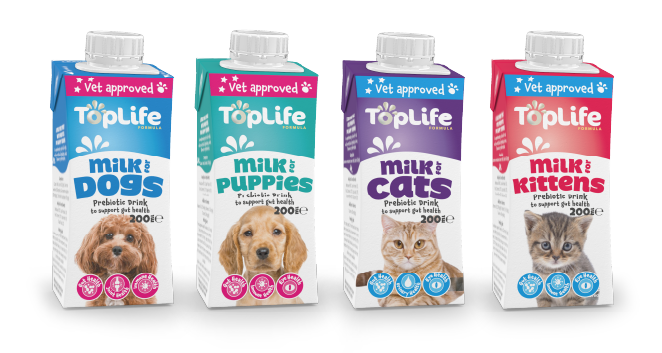


Pet milk isn’t essential to your pet’s diet, but it can be a tasty way to add variety, nutrition and enrichment alongside a complete and balanced diet. TopLife milks are specially formulated for pets with added prebiotic, vitamins and minerals and can be enjoyed as a drink, topper or frozen treat.
Our milks are specially formulated for pets and are different from ordinary cow’s milk. TopLife milk for cats and kittens is made with lactose-reduced cows’ milk, while our milks for dogs and puppies are made with goats’ milk which is much easier for pets to digest and has been used by breeders for years as an important part of a pet's diet. Our milks for dogs, puppies, cats, and kittens also have a prebiotic, to support the good bacteria in your pets digestive system.
As with any new addition to your pet’s diet, we recommend introducing TopLife gradually. You may wish to dilute it with a little water initially, allowing your pet to get used to the taste and texture.
Many pets can find ordinary cow’s milk difficult to digest because it contains lactose. TopLife is specially formulated using ingredients selected with their nutritional needs in mind.
Our milk for dogs and puppies are made with goats’ milk, while our milk for cats and kittens use lactose-reduced cows’ milk which are much gentler on your pets tummy ,plus we’ve added prebiotics and vitamins making toplife a great nutritional addition to your pets diet.
Yes, TopLife can be enjoyed regularly as part of a balanced diet, provided it is given in moderation and according to the feeding guidelines.
TopLife is a treat, so it should be given alongside your pet’s normal complete and balanced diet and fresh drinking water. Treats should make up no more than 10% of a pets daily intake. You can serve our milks as a drink, pour them over food as a tasty topper or use them in enrichment activities such as lick mats and frozen treats.
This depends on the product, so always check the individual packaging for the recommended age.
Our milk for dogs, cats and bedtime milk are suitable for pets aged 12 months and over. We also have milk for puppies and milk for kittens specifically formulated for younger pets over 6 weeks.
Once opened, TopLife should be kept refrigerated and consumed within 3 days. Always follow the storage instructions on the individual product packaging and keep the carton sealed when not in use. You should always use before the Best Before Date.
If you have frozen TopLife as an enrichment treat, keep it frozen until you're ready to serve it.
If your pet has a known food allergy or intolerance, always check the full ingredient list before giving them TopLife.
Our different products contain different ingredients, so it's important to check the individual product information rather than assuming the whole range is suitable. If your pet has a diagnosed allergy or you are unsure whether a product is suitable, we recommend speaking to your vet before introducing it.
A natural diet for a puppy is its mother’s milk. If however there is a problem with the mother or the puppy is orphaned or needs supplementation due to a very large litter a puppy can be fed a follow on milk. As the digestive system is still very immature some puppies find it difficult to digest cow’s milk due to the large proteins in the milk and some puppies simply cannot breakdown the sugars in cow’s milk.
Similar digestive problems can occur in adult dogs too but usually a small amount of dairy is ok. You could also consider dairy alternatives available which might be more easily digestible such as goat’s milk, soya milk or rice milk if you are looking to give your dog a dairy treat.
Lactose intolerance is the inability to digest lactose, the sugar found in milk. Generally, there is insufficient lactase present in the body; this is the enzyme that breaks the lactose down into its individual sugar components glucose and galactose.
In most cases lactose intolerance can cause symptoms which may include abdominal bloating, cramps, flatulence, diarrhoea, nausea or vomiting.
Generally you would notice signs of abdominal bloating, cramps, flatulence, diarrhoea, nausea or vomiting after consumption of milk or dairy products.
A natural diet for a puppy is its mother’s milk. If however there is a problem with the mother or the puppy is orphaned or needs supplementation due to a very large litter a puppy can be fed a follow on milk. As the digestive system is still very immature some puppies find it difficult to digest cow’s milk due to the large proteins in the milk and some puppies simply cannot breakdown the sugars in cow’s milk.
Similar digestive problems can occur in adult dogs too but usually a small amount of dairy is ok. You could also consider dairy alternatives available which might be more easily digestible such as goat’s milk, soya milk or rice milk if you are looking to give your dog a dairy treat.
No. Goats' milk is very gentle even on a puppy's immature digestive system and shouldn't upset the stomach. If your puppy or dog does however suffer from an adverse reaction it is always sensible to consult your vet immediately.
Puppies are generally very resilient in relation to their health; however any concerns should be discussed with your vet immediately.
Goats' milk can be given to puppies or dogs as often as you like. It is ideal on its own to help with weaning or mixed with solid food to encourage lapping. It can also offer a delicious treat for your dog as they grow into adults.
Dogs are very clever and are able to regulate their water balance very well. If they require water they will drink! Goats' milk is nearly 89% water and so they will easily manage to modify their water balance. You should always make sure there is plenty of fresh drinking water available for your dog at all times.
Goats' cheese manufactured from goats' milk will have the majority of the water removed during processing and so goats' cheese is more dense and concentrated. The levels of fat are therefore much higher and should be monitored for a puppy or dog as this can lead to obesity. The proteins are also more concentrated which may pose more of a problem for a young pup as these may prove harder to digest at this early stage of development. Adult dogs may happily enjoy a small amount of goats' cheese in moderation.
All treats should be given in moderation. An additional treat to the diet should be accounted for in the overall energy of the diet. Treats shouldn't make up any more than 10% of the total energy intake of the puppy or dog on a daily basis. Try to look for healthy treat options made with natural ingredients.
Treats shouldn't make up any more than 10% of the total energy intake of the puppy or dog on a daily basis.
A puppy or dog needs to gain all its nutrition from what it consumes. Your pet needs a balanced diet to ensure all the nutritional needs are met. Most good quality dog foods provide all the daily essential nutrition. Look out for high meat content in the products you buy. Also, grain free products and those made without any artificial flavours, added sugars or preservatives will ensure you are feeding your pet the best possible quality.
Different stages of a dog's life necessitate very specific nutritional requirements. These are very specific and so you need to be careful when planning your dogs feeding. A complete balanced age appropriate food will provide you with all the essential nutrients that a pet requires. There are also specific demands to consider during different stages of development. For example as a puppy your pet's metabolism will be at its peak as it grows at an immense rate. This high demand needs to be met with higher calories from a balanced nutritionally complete quality food. This is fundamental as this will ensure the foundations of growth are met. As the dog ages the metabolic rate slows down and the needs of the pet are slightly different. The life stage of a pet is critical to its feeding. If you are in any doubt consult your vet.
It is essential when buying a puppy that you liaise directly with the breeder to determine what the puppy has been weaned onto. This can vary depending on the breeder's preference and breed of dog. A good quality complete balanced puppy food will provide you with the best possible start in life.
Both puppies and dogs require a vast range of essential vitamins and minerals to thrive. A nutritionally complete balanced food should provide you with all the essential nutrients for a puppy or dog. These will be detailed on the label of the pet food.
All good quality complete pet foods should contain a balance of vitamins and minerals. Key ones to look out for are:
Vitamin A — for maintaining healthy hair, skin, eyes, muscles, nerves and ovaries
Vitamin D — for proper nerve and bone formation and muscle function
Vitamin E — for proper cell respiration, fat metabolism and hormone production.
Iodine — for proper metabolism and thyroid function
Copper — for proper formation of bone, tissue, and cells
Iron — for red blood cell production and energy metabolism
Manganese — for enzyme function, bone development and nerve function
Selenium — for defence against oxidative damage from free radicals as selenium will act as an antioxidant
Here at TopLife we also add glucosamine & chondroitin to the milk to help support and maintain supple joints and renew cartilage and Vitamin C to support the immune system.
Glucosamine is a combination of sugar and protein and occurs naturally in connective tissues and cartilage… vital for healthy movement in joints. Joint cartilage is one of the first tissues to age and has relatively poor powers of regeneration due to the poor blood supply to the area, even in a healthy animal.
The delicate balance between wear and renewal can easily be upset. A strain, repeated heavy use, or poor nutrition can all lead to progressive degeneration of the joint.
When joints become strained or injured, a greater amount of synovial fluid is produced, as are enzymes which can actually degrade the cartilage and synovial fluid. Often the animal's body cannot produce enough glucosamine to keep up the rate of repair that would be necessary, especially with the slowing body systems of older animals. That's why we add glucosamine to TopLife Milk for Dogs… to help speed the repair process.
Chondroitin is the major constituent of cartilage and connective tissue. Together with glucosamine it supports the repair and renewal of damaged or worn cartilage. It also acts as an antioxidant, helping neutralise these enzymes and optimise the quality of the synovial fluid.
A natural diet for a kitten is its mother's milk. If however there is a problem with the mother or the kitten is orphaned or needs supplementation due to a large litter a kitten can be fed a follow on milk. As the digestive system is still very immature some kittens find it difficult to digest ordinary cows' milk due to the large proteins in the milk and some kittens simply cannot breakdown the sugars in cows' milk. Special follow on milks are designed to ensure easy digestion even for the most immature digestive system.
Lactose intolerance is the inability to digest lactose, the natural sugar found in milk. There is generally insufficient lactase present in the system, the enzyme that breaks the lactose down into its individual sugar components glucose and galactose. In most cases lactose intolerance can cause symptoms which may include abdominal bloating, cramps, flatulence, diarrhoea, nausea or vomiting.
Generally you would notice signs of abdominal bloating, cramps, flatulence, diarrhoea, nausea or vomiting after consumption of milk or dairy products.
Lactose reduced cows' milk is easier for the cats and kittens to digest and enables them to enjoy milk without experiencing the symptoms of lactose intolerance.
No. Lactose reduced cows' milk is very gentle even on the digestive system and shouldn't upset them. If your kitten/cat does however suffer from an adverse reaction it is always sensible to consult your vet immediately.
It can be given to kittens or cats as often as you like. It is ideal on its own to help with weaning or mixed with solid food to encourage lapping. It can also offer a delicious treat for your cat as they grow into adults.
Unlike dogs, cats don't have the innate instinct to regulate their water balance very well. It is often very difficult to get a cat to drink and so many vets recommend wet food or supplemented milks to try to encourage them to drink. Lactose reduced cows' milk is nearly 89% water so this will inevitably help. You should always make sure there is plenty of fresh drinking water available for your cat or kitten at all times.
All treats should be given in moderation. Any additional treat to the diet should be accounted for in the overall energy of the diet. Treats shouldn't make up any more than 10% of the total energy intake of the kitten or cat on a daily basis. Try to look for healthy treat options made with natural ingredients.
Treats shouldn't make up any more than 10% of the total energy intake of the kitten or cat on a daily basis.
A kitten or cat needs to gain all its nutrition from what it consumes. Your pet needs a complete balanced diet to ensure all the nutritional needs are met. Most good quality cat foods provide all the daily essential nutrition. Look out for high meat content in the products you buy. Also, grain free products and those made without any artificial flavours, colours, added sugars or preservatives will ensure you are feeding your pet the best possible quality.
Different stages of a kittens/cats life necessitate very specific nutritional requirements. These are very specific and so you need to be careful when planning your kittens/cats feeding. A complete balanced age appropriate food will provide you with all the essential nutrients that a pet requires. There are also specific demands to consider during different stages of development. For example, as a kitten, your pet's metabolism will be at its peak as it grows at an immense rate. This high demand needs to be met with higher calories from a balanced nutritionally complete quality food. This is fundamental as this will ensure the foundations of growth are met. As the kitten/cat ages the metabolic rate slows down and the needs of the pet are slightly different. The life stage of a pet is critical to its feeding. If you are in any doubt consult your vet.
It is essential when buying a kitten that you liaise directly with the breeder to determine what the kitten has been weaned onto. This can vary depending on the breeder's preference and breed of cat. A good quality complete balanced kitten or cat food will provide you with the best possible start in life. For cats of all ages, high meat content will be better than low meat content, cats are carnivores after all.
Kitten and cats require a range of essential vitamins and minerals to thrive. A nutritionally complete balanced food should provide you with all the essential nutrients for your pet. These will be detailed on the label of the pet food.
All good quality complete pet foods should contain a balance of vitamins and minerals. Key ones to look out for are:
Vitamin A — for maintaining healthy hair, skin, eyes, muscles, nerves and ovaries
Vitamin D — for proper nerve and bone formation and muscle function
Vitamin E — for proper cell respiration, fat metabolism and hormone production.
Iodine — for proper metabolism and thyroid function
Copper — for proper formation of bone, tissue, and cells
Iron — for red blood cell production and energy metabolism
Manganese — for enzyme function, bone development and nerve function
Selenium — for defence against oxidative damage from free radicals as selenium will act as an antioxidant
Taurine — this is an essential component of the diet for cats as cats cannot metabolise this themselves. Taurine helps to ensure eye health, optimum heart function and nerve control.
Kittens/cats are generally healthy pets however any concerns should be discussed with your vet immediately.
Be the first to hear about the latest news, competitions, giveaways, and exciting opportunities from Top Life.